Academy
Turn strategy into messaging.
Lesson 7
30 mins
Learn how to turn your audience, positioning and value proposition into a clear messaging system, decide what should lead, and build a small set of ideas the market can actually remember.
A strategy nobody can understand will never become a perception customers remember.
At this point, you have done a lot of thinking.
You know what the business is trying to accomplish.
You know who matters most.
You know what you want the brand to be known for.
You know what value the customer should receive.
But customers will never see your strategy document.
They experience the conclusions.
Through a website headline.
A sales presentation.
A product page.
An advertisement.
A proposal.
A salesperson explaining the company in thirty seconds.
Messaging turns the strategy into ideas people can actually understand, remember and repeat.
What we'll cover
• What brand messaging actually is
• The difference between strategy, messaging and copy
• How to build a hierarchy instead of saying everything at once
• What makes a strong messaging pillar
• Why repetition builds meaning rather than making a brand boring
• How to connect every important message to proof
Messaging is what the brand needs people to understand.
Messaging is not every sentence a company will ever write.
It is the small set of ideas the brand needs to communicate consistently in order to shape how customers understand it.
Suppose a cybersecurity company has decided it wants to become known as the specialist for healthcare businesses without large internal security teams.
Its messaging might need customers to understand:
We specialize in healthcare security.
You can get enterprise-level protection without building an enterprise-sized team.
Our specialists monitor your environment continuously.
We understand the compliance requirements surrounding patient data.
Those ideas could later appear in hundreds of different forms.
The website may phrase them one way.
A salesperson may explain them another way.
An advertisement may communicate only one of them.
But underneath the copy, the same strategic messages remain.
That is the system.
Strategy, messaging and copy are not the same thing.
These layers are easy to blur together.
Strategy decides the idea.
For example:
We want established business owners to see us as the specialist that makes their company easier to choose at a higher price.
That is strategic direction.
Messaging decides what needs to be communicated.
For example:
We uncover what makes the business worth choosing.
We make that value easier for customers to understand.
We translate the strategy across the places where customers evaluate the company.
Those are messages.
Copy decides how those messages are expressed.
A website headline might say:
Make your value impossible to miss.
A sales deck might say:
Your customers should understand why you cost more before the price comparison begins.
A social post might say:
If your salesperson has to explain your value from scratch every time, the brand is not doing enough work.
Different copy.
Same underlying message.
That distinction matters because copy changes constantly.
Your messaging should be much more stable.
Do not organize messaging around your company. Organize it around the customer's decision.
Companies naturally want to communicate according to their internal structure.
About us.
Our services.
Our methodology.
Our technology.
Our team.
Our values.
The customer is not thinking in those categories.
They are asking:
Do you understand my problem?
Can you solve it?
Why should I choose you instead of another option?
Why should I believe you?
Is this worth the price or effort?
Your messaging should help answer those questions.
That means a service may be important internally but secondary in the customer's decision.
A capability may deserve less attention than a result.
A company history may be useful only when it creates trust.
The messaging hierarchy should follow how customers decide, not how the organization chart is structured.
One idea should lead.
Imagine visiting a website and seeing:
Innovative. Human. Trusted. Sustainable. Premium. Agile. Customer-first. Global. Local. Experienced. Forward-thinking.
The company has technically communicated eleven things.
You probably remember none of them.
Now imagine:
The accounting firm built for companies preparing to sell.
Immediately, there is something to understand.
The company may still need to communicate expertise, process, experience and service.
But now those ideas have a hierarchy.
There is a leading message.
Everything else can support it.
“You cannot bore people into buying your product; you can only interest them in buying it.”
David Ogilvy
Clarity matters, but clarity alone is not enough.
The message still needs to give the customer a reason to care.
Build a message hierarchy.
A strong messaging system usually has levels.
At the top is the core message.
Underneath it are a small number of messaging pillars.
Under each pillar are proof points.
Think of it like this:
Core message
What is the most important idea customers should understand about us?
Pillar 1
Why does that matter?
Pillar 2
What else makes the choice compelling?
Pillar 3
What makes us particularly credible or desirable?
Proof
Why should anyone believe any of this?
You do not need seven pillars.
Three strong messages are usually much more useful than eight weak ones.
Example: a private dental practice.
Suppose the practice's position is:
High-end restorative dentistry for patients who want complex dental work handled with exceptional care and discretion.
Its core message might be:
Complex dental treatment without feeling like a clinical ordeal.
Then the pillars could be:
Specialist expertise
Complex restorative cases are handled by clinicians with deep experience in this kind of work.
A calmer experience
The environment, scheduling and patient care are designed to reduce the stress normally associated with extensive dental treatment.
Results designed to feel natural
Treatment planning prioritizes function and aesthetics so the final result looks like the patient, not the procedure.
Now compare those with:
Quality. Trust. Innovation. Excellence.
The first set actually communicates something.
The second could belong to almost any dentist.
A messaging pillar is not an adjective.
This is an important distinction.
Trusted is not a messaging pillar.
Creative is not a messaging pillar.
Premium is not a messaging pillar.
Innovative is not a messaging pillar.
Those are attributes.
A messaging pillar should communicate an idea the customer can understand and connect to value.
Instead of:
Expertise
say:
You work directly with specialists who have solved this problem before.
Instead of:
Convenience
say:
Everything is handled through one team, so you do not have to coordinate multiple providers.
Instead of:
Personalization
say:
The solution is built around how your company actually operates rather than forcing you into a standard package.
The goal is not to find impressive words.
The goal is to communicate a reason to choose.
Each message should do a different job.
Messaging becomes repetitive in the bad way when three pillars are really saying the same thing.
For example:
Exceptional quality
Uncompromising standards
Excellence in everything
That is one idea wearing three outfits.
A stronger system might be:
Better materials that last longer.
Made to order around your space.
Installed and supported by the same team that designed it.
Now each message gives the customer a different reason to value the company.
Ask of each pillar:
What new reason does this give someone to choose us?
If the answer is “basically the same reason as the previous one,” combine them.
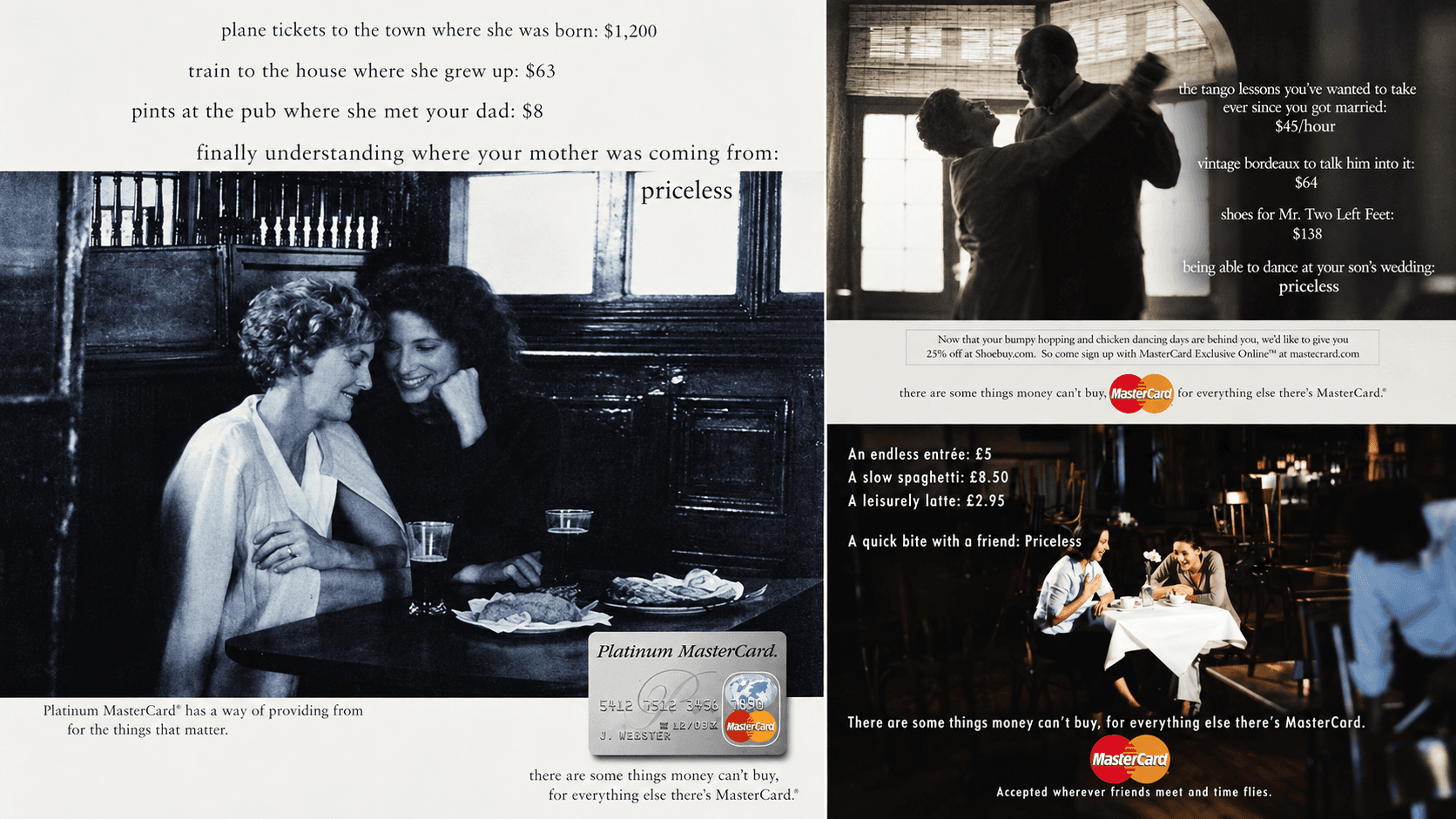
Real example: Mastercard’s “Priceless.”
Mastercard launched Priceless in 1997 with a simple recurring idea: some things can be assigned a price, but the moments that matter most cannot.
The original ads would list the cost of ordinary purchases connected to an experience, then shift attention to the part that could not really be priced: time with someone you love, a celebration, a reunion, a shared memory.
That structure became recognizable enough that Mastercard could use it across completely different situations.
One execution could revolve around baseball.
Another around travel.
Another around family.
Another around food, music or a once-in-a-lifetime experience.
The people changed.
The setting changed.
The specific copy changed.
But the meaning stayed remarkably consistent.
Over time, Mastercard expanded Priceless from an advertising campaign into experiences and programs built around people's passions, but the underlying territory remained centered on the things money enables without pretending that money is the most important part of the experience. Mastercard itself credits that stable strategic foundation with allowing many different creative executions to remain connected over decades.
That is the distinction we need to understand.
Consistency does not mean repeating the same advertisement.
It means repeatedly reinforcing the same idea until customers begin to associate that idea with the brand.
A messaging system should give a company enough structure to become recognizable and enough flexibility to keep saying something interesting.
Repetition is how the market learns what you mean.
Inside a company, people get tired of a message quickly.
They have seen it in:
the strategy presentation
the website draft
the sales deck
the campaign review
the social calendar
the internal meeting
By the tenth time, someone inevitably says:
“We keep saying the same thing.”
Good.
The customer has probably noticed it twice.
Brands are built through accumulated associations.
If every campaign introduces a completely new idea, the company keeps starting from zero.
One month:
We are the innovative one.
The next:
We care the most.
Then:
We are affordable.
Then:
We are exclusive.
Then:
We are sustainable.
Nothing has enough time to become strongly associated with the brand.
Consistency is not saying the same sentence forever.
It is building the same meaning repeatedly.
The message can change shape without changing meaning.
Imagine the core message is:
Our software gives small manufacturers the operational visibility previously available only to much larger companies.
On the homepage:
See your entire operation in one place.
In a sales presentation:
Know what is happening across production before small problems become expensive ones.
In an advertisement:
Your factory should not need a Fortune 500 budget to know what is happening inside it.
In a product demo:
Here is the dashboard showing production, delays and inventory together.
Different words.
Different contexts.
Same strategic message.
That flexibility matters because communication should fit the moment.
A billboard should not read like a proposal.
A proposal should not read like an Instagram caption.
But the brand should still sound like it believes the same things everywhere.
Proof should sit directly underneath the message.
Lesson 6 introduced proof points.
Now we need to attach them to messaging.
Suppose the message is:
Projects move faster because you work directly with senior specialists.
Proof might include:
Every account is led by a senior strategist.
No handoff to junior delivery teams.
Average response time under one business day.
Weekly direct working sessions.
Those facts make the message more credible.
Now compare:
Projects move faster because you work directly with senior specialists.
Proof:
Founded in 2014.
Beautiful office.
Award-winning logo.
Those facts may be true.
But they do not prove the message.
The relationship should be obvious:
Message → Why it matters → Evidence
Messages should answer objections before the customer has to ask.
Good messaging does not only promote benefits.
It can reduce hesitation.
Imagine a high-priced interior design firm.
The customer may be wondering:
Will this become much more expensive than quoted?
Will the result look like the designer rather than me?
Will I have to manage contractors myself?
Those are not necessarily complaints.
They are barriers to choosing.
Messaging could proactively answer them:
A defined investment range before design begins.
A design process built around how you actually live.
One team coordinating the project from concept through installation.
Now the messaging is doing commercial work.
It is making the purchase easier to understand and less risky.
Your messaging needs both desire and clarity.
A perfectly clear message can still be boring.
A highly emotional message can still be meaningless.
You need both.
Compare:
We provide cloud-based project management software.
Very clear.
Not especially compelling.
Now:
Make work magical.
More emotional.
But unless the customer already understands the product, it tells them almost nothing.
The strongest messaging often combines:
What is this?
Why should I care?
Why you?
Not necessarily in one sentence.
But across the system.
Do not make the customer decode your cleverness.
There is a temptation in branding to reward ourselves for writing something unusual.
A line may be witty.
Poetic.
Provocative.
Conceptual.
And still fail.
If the customer has to spend twenty seconds figuring out what the company actually does, the message may be entertaining but commercially weak.
Cleverness is useful when it makes the idea more memorable.
It becomes a problem when it replaces the idea.
Start with meaning.
Then make the language interesting.
Not the other way around.
Messaging and voice are different.
This distinction becomes important in the next lesson.
Messaging is what you say.
Voice is how you say it.
Two brands could communicate the same basic message:
Our software makes accounting easier for small businesses.
One might express it with calm, reassuring language.
Another might be witty and irreverent.
Another might sound highly technical and authoritative.
The message can remain similar.
The personality changes.
For now, concentrate on what must be understood.
We will decide how the brand should sound next.
Build a system your whole company can actually use.
The final test is practical.
Could a salesperson use these messages?
Could a copywriter turn them into a homepage?
Could someone create a proposal from them?
Could a social media manager create content without inventing a completely new brand strategy every morning?
Could the CEO explain the company using the same ideas?
If not, the messaging may still be too abstract.
Good messaging reduces invention.
People still write creatively.
They just know what the creativity is supposed to communicate.
Assignment
• Bring forward your audience, positioning and value proposition from Lessons 4–6.
• Write the one idea you most need customers to understand about the brand.
• Choose three messaging pillars at most, with each giving a different reason to choose you.
• Under each pillar, write why that message matters to the customer.
• Add at least one proof point that makes each pillar believable.
• Check the hierarchy: Core message → supporting messages → proof.
Next Steps
1. Complete the assignment above.
2. Remove any pillar that is only an adjective or repeats another message.
3. Test whether someone outside the company could understand each message without explanation.
4. Keep the ideas stable even if you later rewrite the copy.
5. Continue to Lesson 8: Give the brand a voice.